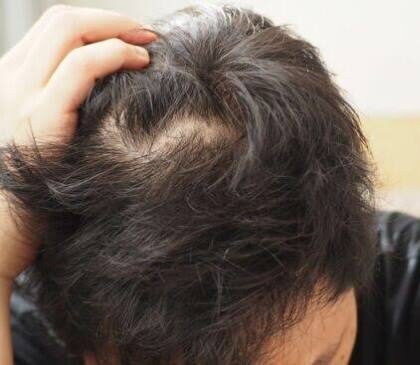
You part your hair and notice flakes.
The immediate reaction may be:
“I have dandruff.”
But visible flaking can occur for different reasons.
What looks like a scalp flake may sometimes be dried styling product, residue, skin flakes, environmental debris, or accumulated product.
That’s why the first step isn’t automatically buying another treatment.
It’s observing what you’re seeing and looking at your routine.
Start with your routine
Ask yourself:
- How long has it been since I cleansed my scalp?
- How many products have I applied since wash day?
- Do I regularly layer gels, oils, edge control, creams, sprays, or dry shampoo?
- Does the residue appear where I use the most product?
- Does washing remove most of what I’m seeing?
- Is my scalp also persistently itchy, red, painful, or uncomfortable?
Those details can help you determine whether routine-related buildup may be part of the picture.
Product buildup can happen to every texture
Buildup isn’t a curly-hair problem.
It isn’t a straight-hair problem.
It isn’t only a protective-style problem.
Anyone who uses hair products can experience accumulation.
The likelihood may increase when multiple products are repeatedly layered without adequate cleansing.
And remember:
Oil does not cleanse old oil or product from the scalp.
Adding more product can temporarily change how the scalp feels, but it does not replace cleansing.
Protective styles need a cleansing plan
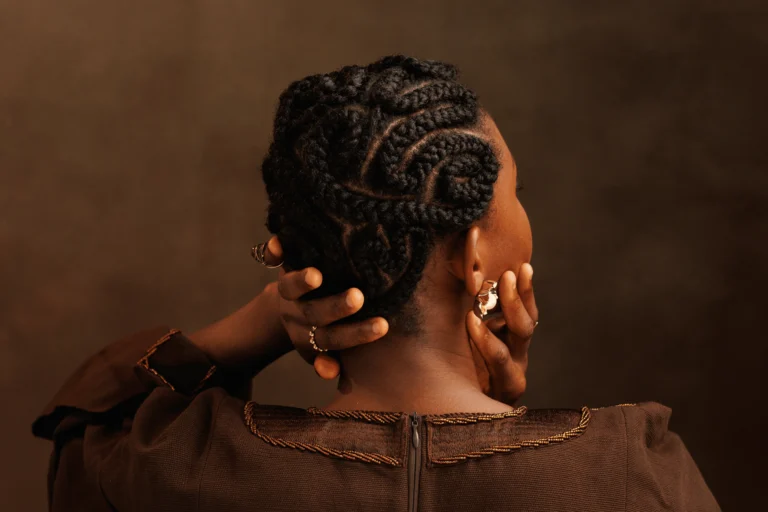
Braids, wigs, sew-ins, twists, locs, and extensions may make scalp cleansing less convenient.
But the scalp still produces oil.
You still sweat.
Products still accumulate.
Environmental debris can still reach the scalp.
Your cleansing technique may need to adapt to your style, but scalp care should not disappear completely.
Flaking deserves context
Not every visible flake has the same cause.
Some flaking may appear alongside dryness.
Some may appear alongside product accumulation.
Some scalp conditions can also cause persistent flaking or scaling.
Baby Hair® cosmetic products are not designed to diagnose the cause of flaking.
If you experience persistent flaking along with significant itching, redness, pain, sores, inflammation, substantial scaling, or hair loss, consider discussing your symptoms with an appropriate healthcare professional.
Cleanse before you keep layering
If your scalp is coated with oil, styling product, sweat, and debris, adding another heavy layer can make it harder to understand what your scalp actually needs.
Sometimes the simplest reset is:
- Cleanse thoroughly.
- Rinse well.
- Condition your hair according to its needs.
- Use scalp products intentionally rather than automatically.
- Observe how your scalp behaves over the following days.
Don’t forget application technique
Products designed for the lengths of your hair do not necessarily need to sit directly on your scalp.
Conditioners, masks, heavy creams, and styling butters may be best concentrated through the hair rather than applied heavily at the roots unless the product directions say otherwise.
Placement matters.